Q u i c k Q u o t e
G e t F r e e Q u o t a t i o n
Q u i c k Q u o t e

If your buyers or crews mainly handle automotive maintenance, light assembly, or general repair work in tight spaces, a 3/8 impact wrench is the more practical, lower-cost choice.
If the end application involves lug nuts, heavy fasteners, structural steel, or industrial assembly where high torque output matters more than compact size, a 1/2 impact wrench is the better fit.
Most professional toolkits — and most wholesale product lines — actually need both, since the two drive sizes serve different torque ranges and job types rather than competing for the same task.
For distributors and importers building out a fastening-tool catalog, stocking both sizes from a single reliable cordless impact wrench manufacturer is usually the smartest way to cover the full range of customer demand.
Below, we break down the 3/8 vs 1/2 impact wrench comparison in detail — torque, size, applications, and price — so you can make confident sourcing and stocking decisions for your business.
The number refers to the square drive size — the anvil that the socket attaches to — not the overall size of the tool. A 3/8-inch drive impact wrench uses smaller sockets rated for lighter fastener sizes, while a 1/2-inch drive impact wrench uses larger sockets built to transmit significantly higher torque without failing. This single measurement drives almost every practical difference between the two tools: weight, torque ceiling, ergonomics, and the applications each one is suited for.

A 3/8 impact wrench is built around compactness and control. It's the size most technicians reach for when a job doesn't require maximum torque but does require maneuverability.
● Lightweight body, usually under 3 lbs (cordless models), reducing operator fatigue during long shifts
● Compact head design for reaching into tight engine bays, cabinetry, or machine housings
● Torque output typically in the 100–400 ft-lbs range, depending on the motor and battery platform
● Fast socket changes thanks to the smaller 3/8-inch drive
● Often paired with variable speed and multiple power settings for precision fastening
● Automotive maintenance (brakes, suspension components, small bolts)
● Furniture and cabinetry assembly
● Appliance repair and light equipment servicing
● General MRO (maintenance, repair, operations) tasks in workshops
● Bicycle and small-engine repair
For distributors selling into automotive aftermarket or light industrial channels, the 3/8 size is typically the higher-volume SKU, since it covers the widest range of everyday repair tasks at a lower price point.
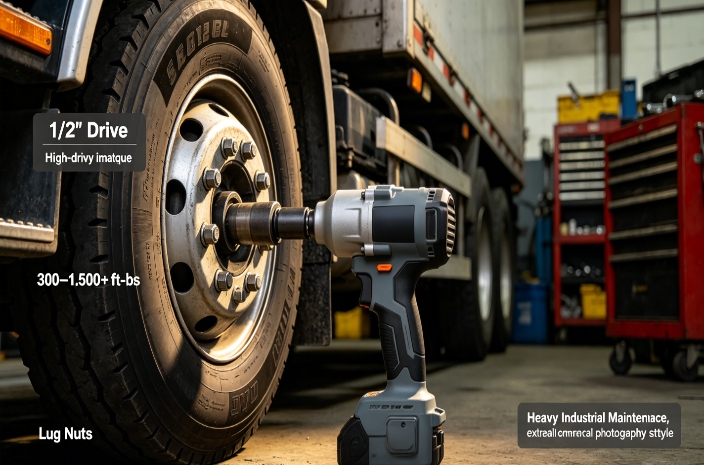
A 1/2 impact wrench trades some compactness for substantially more torque. It's the standard choice wherever fasteners are large, corroded, or under high load.
● Higher-torque brushless motors, commonly delivering 300–1,500+ ft-lbs on professional-grade cordless platforms
● Reinforced anvil and gearbox built to handle repeated high-impact cycles
● Larger, heavier housing (though modern brushless designs have narrowed this gap considerably)
● Multiple torque-control modes to prevent over-tightening on sensitive fasteners
● Compatible with larger battery packs for extended runtime on demanding jobs
● Tire and wheel service (lug nut removal and installation)
● Heavy-duty automotive and truck repair (suspension, drivetrain, engine mounts)
● Structural and construction fastening
● Industrial assembly lines and equipment maintenance
● Agricultural and heavy equipment servicing
For tool distributors serving garages, fleet maintenance operations, or construction contractors, the 1/2-inch drive is usually the tool buyers specifically ask for by name — it's the segment where torque specs and brand reliability matter most in the purchase decision.
| Factor | 3/8 Impact Wrench | 1/2 Impact Wrench |
|---|---|---|
| Typical torque range | 100–400 ft-lbs | 300–1,500+ ft-lbs |
| Weight (cordless) | Lighter, ~2–3 lbs | Heavier, ~3–5 lbs |
| Best for | Light to medium fastening, tight spaces | Heavy-duty fastening, large bolts |
| Common end users | Auto techs, DIY, appliance repair | Fleet mechanics, construction, industrial |
| Socket compatibility | 3/8" drive sockets | 1/2" drive sockets |
| Typical price positioning | Lower cost, higher sales volume | Higher cost, higher margin per unit |
| Battery drain (cordless) | Lower, longer runtime per charge | Higher, especially at max torque |

Torque is the deciding factor in most purchasing conversations. A 3/8 impact wrench comfortably handles the fasteners found on cars, small machinery, and household repairs, but it will struggle with heavily corroded lug nuts or large structural bolts. A 1/2 impact wrench is engineered specifically for that higher-resistance work, which is why it remains the standard tool in tire shops and heavy equipment bays.
Because the 3/8 impact wrench is smaller and lighter, it's easier to use one-handed and for extended periods without operator fatigue — an important consideration for buyers outfitting large repair or assembly teams. The 1/2 impact wrench is bulkier, but modern brushless motors and lithium-ion battery platforms have significantly reduced the weight penalty compared to older models, making today's 1/2-inch tools far more comfortable than the corded or pneumatic versions many end users are replacing.
From a wholesale perspective, versatility isn't just about what one tool can do — it's about how well a product line covers your customer base. A 3/8 impact wrench sells well to DIY, automotive, and general repair segments where price sensitivity is higher. A 1/2 impact wrench sells into professional and industrial channels where torque specs, durability certifications, and brand trust drive the purchase. Carrying both sizes under a consistent brushless platform lets distributors cross-sell batteries and accessories across the whole line, which improves margin per customer.
3/8 impact wrenches generally cost less to manufacture and retail for less, making them a strong entry-level or high-turnover SKU. 1/2 impact wrenches command higher price points because of stronger motors, reinforced internals, and higher torque testing requirements — but they also carry stronger margins and repeat business from professional buyers who replace tools less often but expect higher build quality. Before finalizing a purchase order, it's worth confirming torque test data, IP rating, battery compatibility, and warranty terms with your supplier, since these specs directly affect resale positioning in your target market.
Use this checklist when deciding which size — or which mix of both — fits your product catalog:
● Target end user is automotive DIY, light repair, or appliance service? → Prioritize 3/8 impact wrench SKUs.
● Target end user is tire service, fleet maintenance, or construction? → Prioritize 1/2 impact wrench SKUs.
● Your customers ask for torque above 500 ft-lbs? → Stock 1/2-inch models with high-torque brushless motors.
● Your customers need long runtime and lighter tools for daily carry? → Stock 3/8-inch models on a shared battery platform.
● You want to reduce SKU complexity while covering more use cases? → Offer a combo kit with both drive sizes on one battery system.
If you're still narrowing down your product lineup, our earlier guide on how to choose the best impact wrench for your application covers torque charts and selection criteria in more depth.
A: Not for heavy-duty work. A 3/8 impact wrench is designed for lower torque ranges, and pushing it beyond its rated output shortens tool life and reduces fastening accuracy. For lug nuts, structural bolts, or industrial assembly, a 1/2 impact wrench is the correct tool.
A: Both move well, but for different reasons. 3/8 impact wrenches typically drive higher unit volume due to broader DIY and light-repair demand, while 1/2 impact wrenches typically drive higher revenue per unit due to professional and industrial buyers who prioritize torque and durability over price.
A: No — each drive size requires its own matching sockets. Adapters exist, but they're generally discouraged for high-torque applications since they can reduce accuracy and increase wear.
A: For general automotive and light industrial use, 500–800 ft-lbs is typically sufficient. For heavy equipment, truck fleets, or structural fastening, look for models rated at 1,000 ft-lbs or higher.
Whether your customers need the compact control of a 3/8 impact wrench or the raw torque of a 1/2 impact wrench, PWR TOOLS gives you a single, ISO-certified manufacturing partner for both. Our brushless cordless impact wrenches — including high-torque models like the 21V 1500N·m cordless impact wrench — are built with all-copper core motors, IP54-rated housings, and triple-bearing anvils tested for 10,000+ cycles at peak torque, so you can offer your customers proven durability at competitive factory-direct pricing.
We support importers, wholesalers, and brand owners with OEM/ODM services, flexible MOQs, and full pre-shipment quality inspection across our impact wrench range. If you're ready to expand your fastening-tool catalog or need help selecting the right torque specs for your target market, get in touch with our team for a free quote and product catalog — let's power up your business together.
Latest News

Top 10 Power Tool Brands in China
Jul. 02, 2026Products List
Hot Products


Unlock The Potential of Your Business With PWRTOOLS.
Fields marked with an asterisk (*) are required. We will respond to you as soon as possible. You can also reach us via email at info@pwrtools.com.
Let's power up your success together!
Get Your Free Catalog
Please provide your contact details below, and we’ll reach out to you shortly.